.png)

Part of the Smarter, Greener Homes series: Practical guides to understanding energy efficiency, home performance and green-building features.
New windows.
More insulation.
A heat pump.
Air sealing.
Solar panels.
If you're trying to make a home more energy efficient, there's no shortage of places to spend money.
But which upgrade actually gives you the best return?
I wish there were a simple answer.
Something like:
“Always replace the windows first.”
or:
“A heat pump is always the best investment.”
There isn't.
Because the value of an energy upgrade depends heavily on what's wrong with the house before you make it.
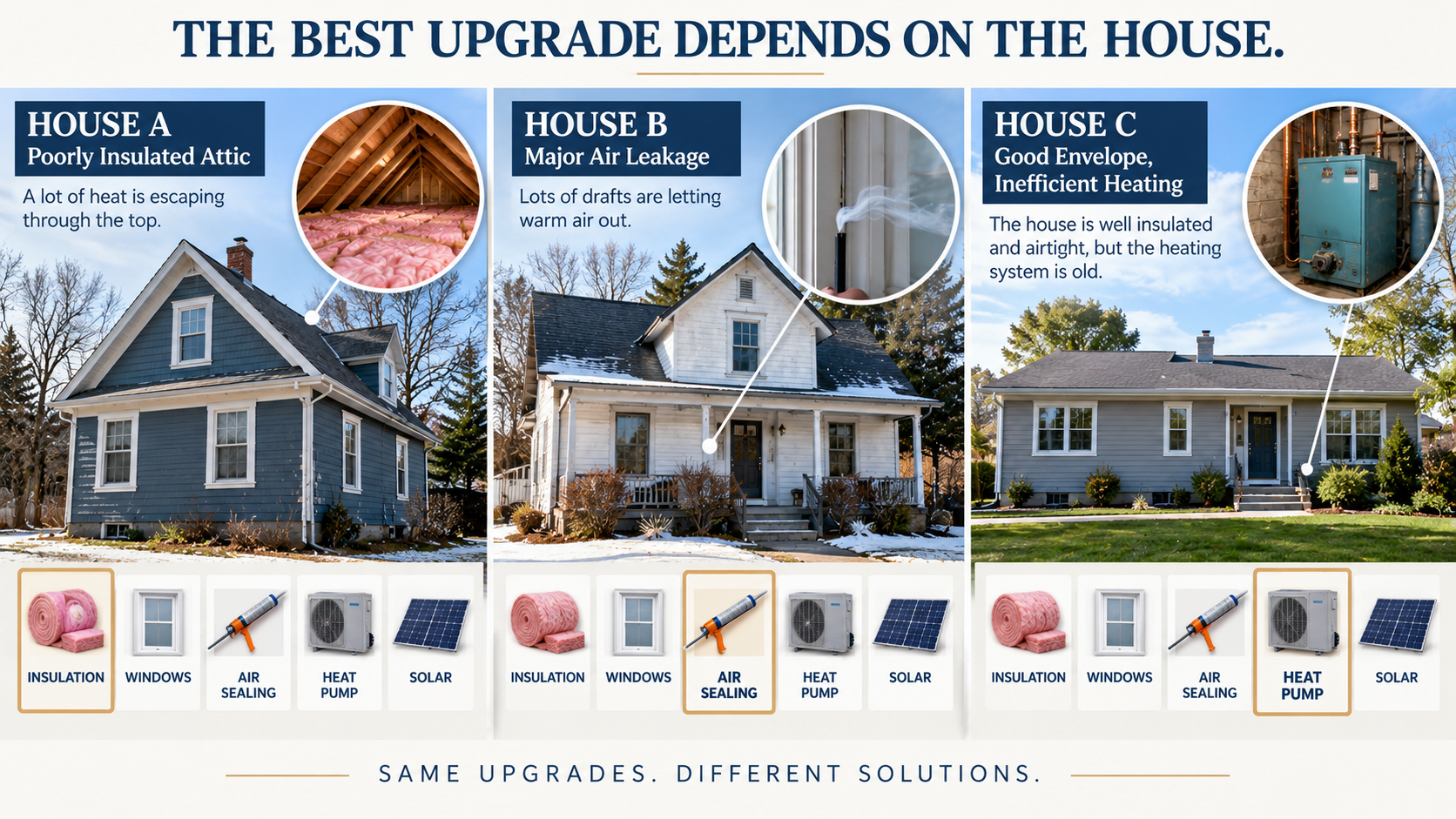
A house with an under-insulated attic has a different problem from one with excellent insulation but an aging oil furnace.
A drafty century home has different priorities from a relatively airtight 15-year-old home.
And a house with inexpensive heating but poor windows may have different goals again—especially if comfort, condensation or maintenance are part of the decision.
Natural Resources Canada recommends thinking of the home as a system, because the building envelope, heating and cooling equipment, ventilation, occupants and other components all interact. Changing one can affect the others. Natural Resources Canada
So instead of asking:
“Which energy upgrade has the best payback?”
I think the better question is:
“Which upgrade addresses the biggest problem in this particular house?”
1. First, What Does “Pay Off” Actually Mean?
When people talk about return on an energy-efficiency upgrade, they're often talking about one thing:
How long will it take the energy savings to equal what I spent?
That's simple payback.
If an upgrade costs $5,000 and somehow saves exactly $500 per year, its simple payback would be 10 years.
But real houses aren't usually that simple.
An upgrade can also provide:
better comfort
fewer drafts
more consistent room temperatures
less condensation
quieter operation
cooling in summer
reduced maintenance
replacement of something that was already failing
lower greenhouse-gas emissions
potentially greater appeal to future buyers
And some improvements need to be made whether they produce an exciting energy return or not.
If your windows are rotting, you're eventually going to deal with them.
If your furnace is at the end of its life, you're going to need another heating system.
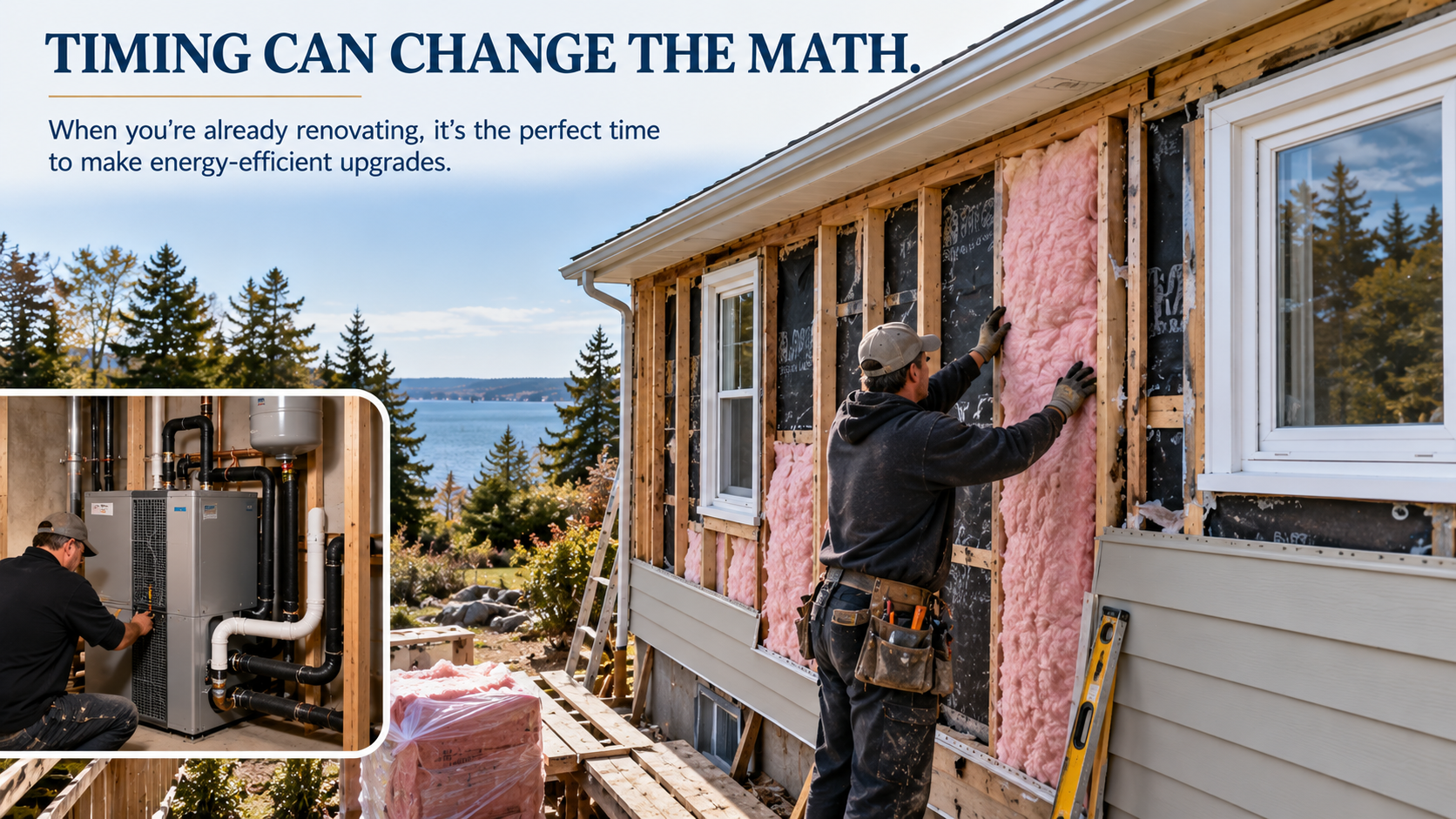
If you're already replacing siding, that may create an opportunity to improve wall insulation at a much lower incremental cost than opening the walls solely for insulation.
So there are really two questions:
Will this upgrade reduce energy consumption?
and
Does it make financial sense to do it now?
Those aren't always the same question.
2. The Best Upgrade Usually Fixes a Weakness
Imagine a house with:
good windows
a relatively efficient heat pump
reasonable wall insulation
almost no attic insulation
Would replacing the windows again make sense?
Probably not as your first energy upgrade.
Now imagine another house:
well-insulated attic
insulated basement
reasonably airtight
25-year-old heating equipment
high-cost heating fuel
Adding another layer of attic insulation may not be where I'd start either.
That's the problem with universal retrofit rankings.
The same upgrade can be extremely valuable in one house and relatively insignificant in another.
The starting point matters.
Where Does Your Heating Dollar Actually Go?
3. Air Sealing: Often Not Glamorous, but Important
Nobody invites the neighbours over to admire their new caulking.
Air sealing doesn't have the visual impact of new windows or solar panels.
But from an energy-efficiency standpoint, it can be extremely important.
NRCan calls air-leakage control the single most important retrofit activity and says it should be considered first in an upgrade strategy. Natural Resources Canada
Why?
Because every time heated indoor air escapes, outdoor air replaces it.
And in winter, your heating system has to heat that replacement air.
Potential leaks can occur around:
attic penetrations
windows and doors
plumbing
electrical fixtures
chimneys
sill plates
foundations
additions
exhaust penetrations
Some air-sealing work can also be relatively inexpensive compared with major equipment or window replacement.
But here's the important qualification:
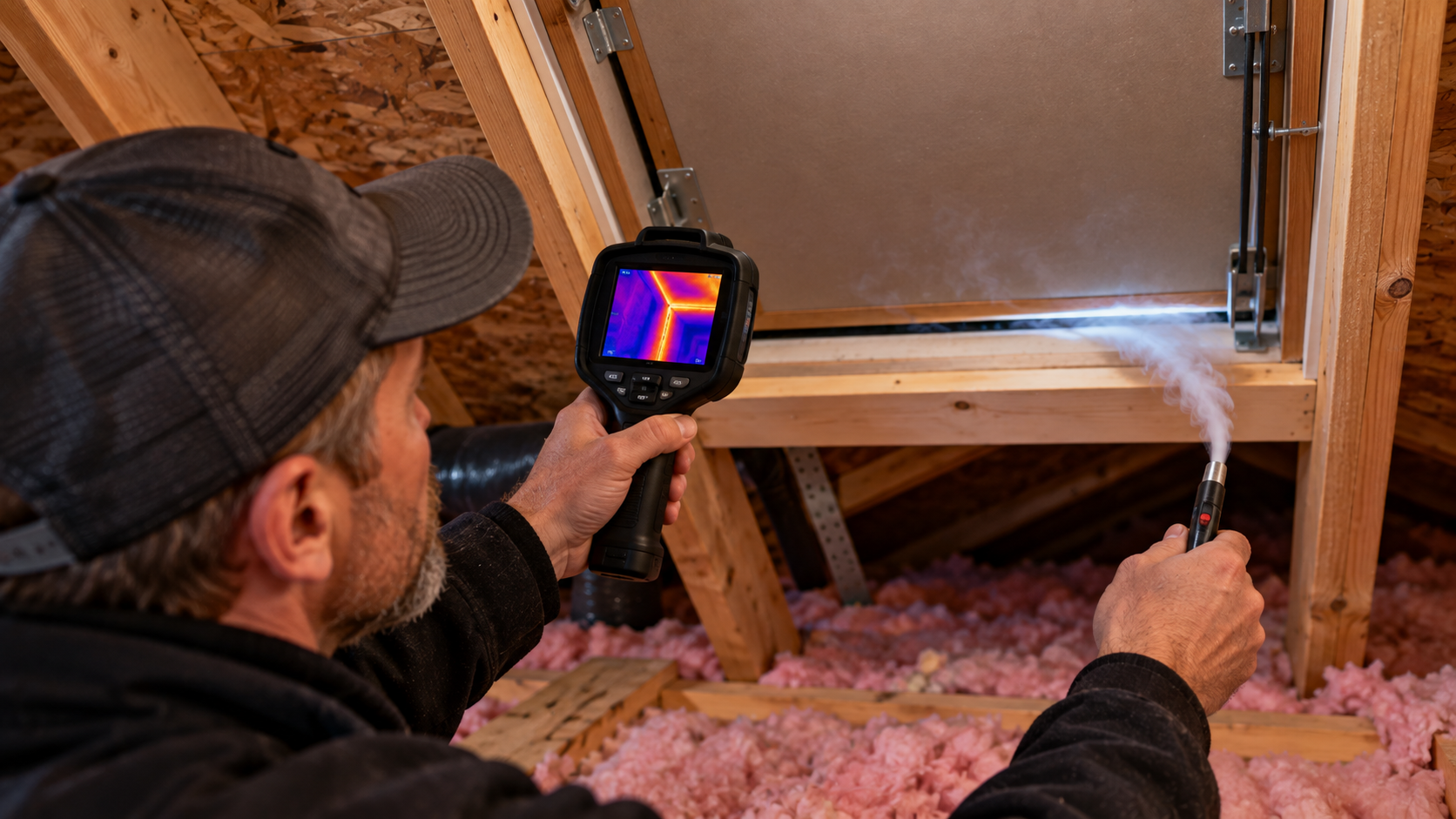
You still need to know where the house is leaking.
A blower-door test can help locate and quantify leakage instead of simply applying caulking everywhere and hoping for the best.
And as a house becomes tighter, ventilation also needs to be considered. NRCan specifically cautions that changes to the building envelope and air sealing can affect ventilation. Natural Resources Canada
So air sealing can be a very good investment.
But it should still be done as part of understanding the whole house.
Your House May Be Leaking Money — Understanding Air Sealing
4. Insulation: Sometimes the Obvious Opportunity
Insulation is another upgrade where the starting point matters enormously.
Going from very little insulation to a well-insulated assembly can be a very different investment from adding even more insulation to an area that's already performing reasonably well.
That's because insulation experiences diminishing returns.
Each additional amount of insulation can still reduce heat flow, but the improvement isn't linear.
Doubling the R-value doesn't mean you'll cut your heating bill in half.
So if I were considering insulation, I'd first ask:
Where is insulation actually lacking?
The attic?
Exterior walls?
Basement?
Rim joist?
An addition?
Sometimes the opportunity is obvious.
An accessible attic with inadequate insulation can be relatively straightforward to improve.
Insulating finished exterior walls may involve considerably more labour and disruption.
And timing can completely change the economics.
If you're already replacing siding, renovating a basement or opening walls for another reason, insulation that might otherwise be expensive to access can suddenly become much more practical.
The best time to improve insulation may be when the house is already open.
Insulation: What Do R-Values Actually Mean?
5. Windows: The Upgrade Everyone Wants to Do
Windows are interesting because they're one of the first upgrades many homeowners think about.
They're visible.
They're easy to understand.
New windows look good.
And poor windows can absolutely contribute to heat loss, drafts and discomfort.
NRCan says windows, doors and skylights can account for up to 35% of total house heat loss. Natural Resources Canada
That sounds like an obvious argument for replacing every window.
Except it isn't.
The real question is:
What condition are the existing windows in?
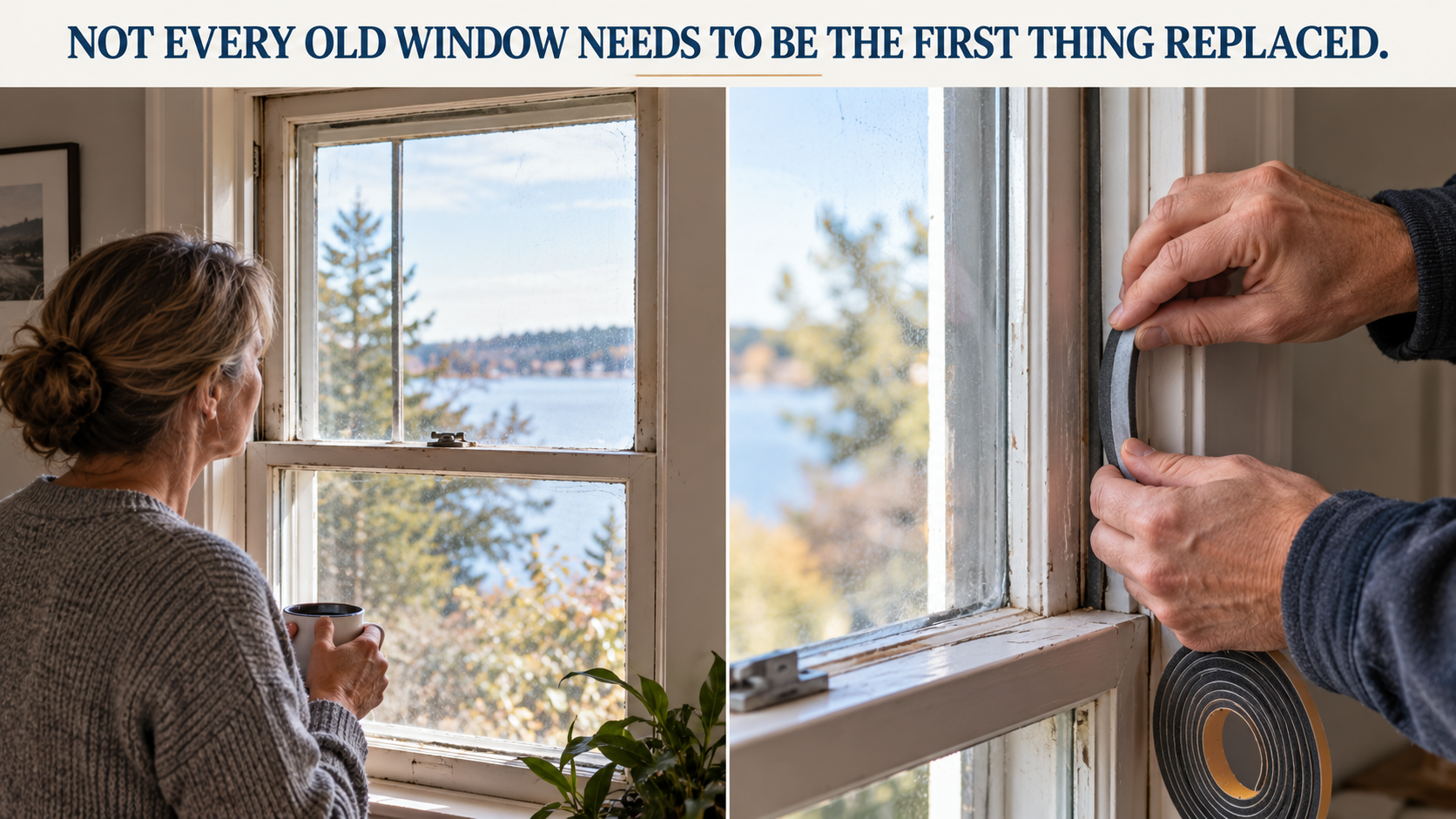
A failed, drafty, deteriorated window is different from a reasonably good double-pane window that's properly installed and sealed.
And replacing an entire window isn't the only possible improvement.
Depending on the situation, you may be dealing with:
deteriorated weatherstripping
failed caulking
air leakage around the frame
failed insulated glass
poor installation
condensation
genuinely poor-performing glazing
That's why I wouldn't recommend replacing good windows solely because a newer window has a better performance rating.
The improvement may be real.
That doesn't automatically make it the best place to spend the next renovation dollar.
Triple-Pane Windows: Worth the Extra Cost?
6. Heat Pumps: A Different Kind of Upgrade
A heat pump is different from insulation or air sealing.
Insulation and air sealing primarily reduce the amount of heat the house loses.
A heat pump changes how efficiently you produce that heat.
That distinction matters.
A cold-climate air-source heat pump can offer substantial operating-cost advantages when replacing or displacing certain heating systems. NRCan's Canadian cold-climate heat-pump study found operating costs lower than electric-resistance or oil furnaces for space heating in all Canadian regions it studied. Natural Resources Canada
That's particularly relevant in Nova Scotia, where oil and electric-resistance heating remain common.
But even then, the numbers depend on:
what you're replacing
electricity prices
fuel prices
heat-pump efficiency
sizing
installation
outdoor temperatures
backup heat
how you operate the system
how much heat the house actually needs
NRCan stresses that proper selection, sizing and installation are critical to maximizing heat-pump energy savings. Natural Resources Canada
There's also another benefit that's easy to leave out of a simple payback calculation:
A heat pump provides air conditioning.
If you were going to purchase cooling anyway, part of the heat-pump cost may be providing a benefit that isn't captured by comparing winter heating bills alone.
So again:
Context matters.
Heat Pumps: Are They Really Cheaper to Run in Nova Scotia?
7. What If the House Is Leaky AND Has an Inefficient Heating System?
Now we get to the more interesting cases.
Suppose a house has:
substantial air leakage
inadequate attic insulation
an old oil furnace
Should you improve the envelope first?
Or install the heat pump first?
There isn't always one correct sequence.
But there's a useful principle:
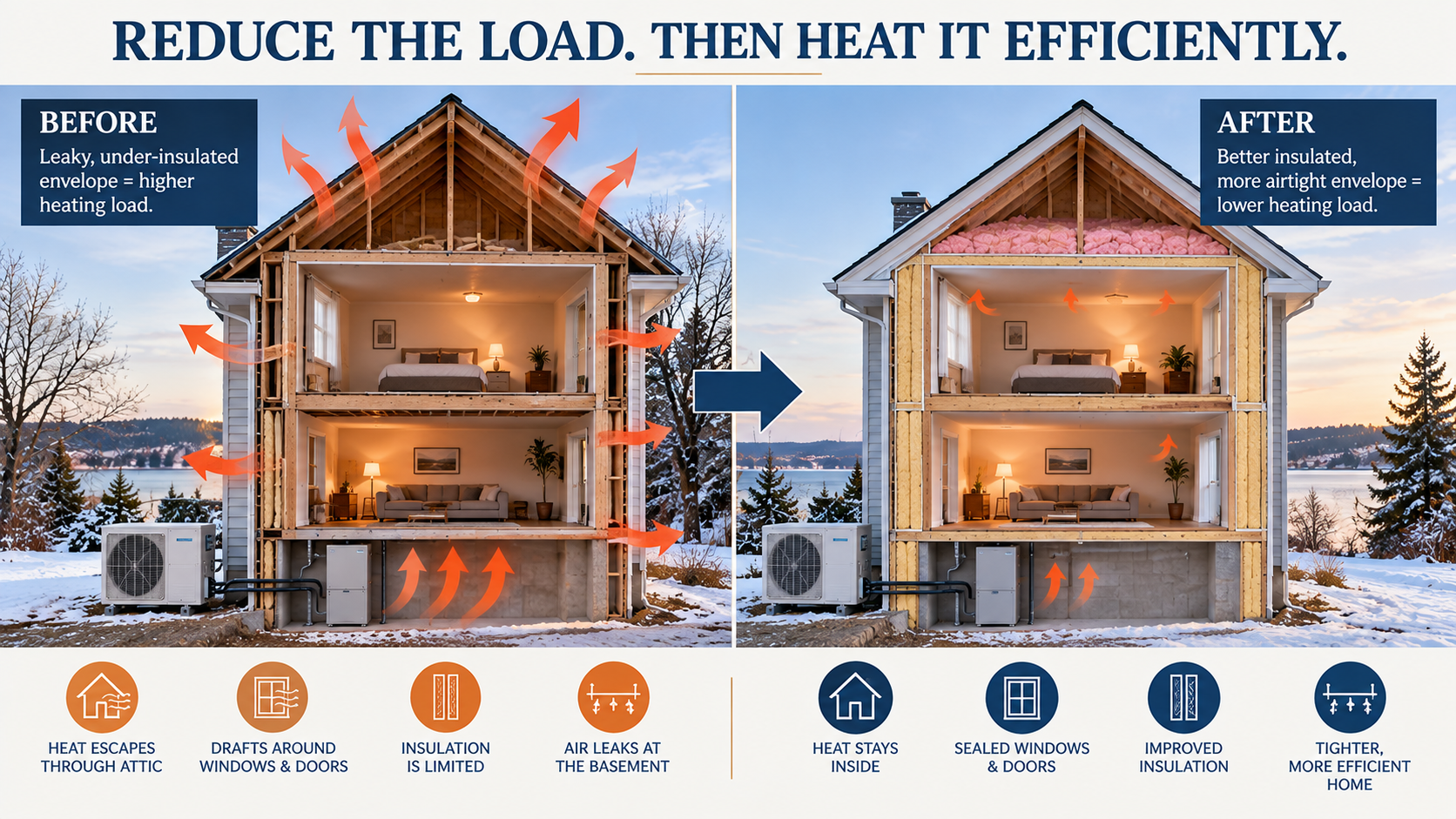
Reducing the heating load can change the heating equipment the house needs.
If you're planning significant insulation and air-sealing improvements, the house may require less heat afterward.
That can affect equipment sizing.
Conversely, if the existing heating equipment is failing and needs immediate replacement, you may not have the luxury of completing the entire building envelope first.
This is why energy upgrades should be thought of as a plan, rather than a collection of unrelated purchases.
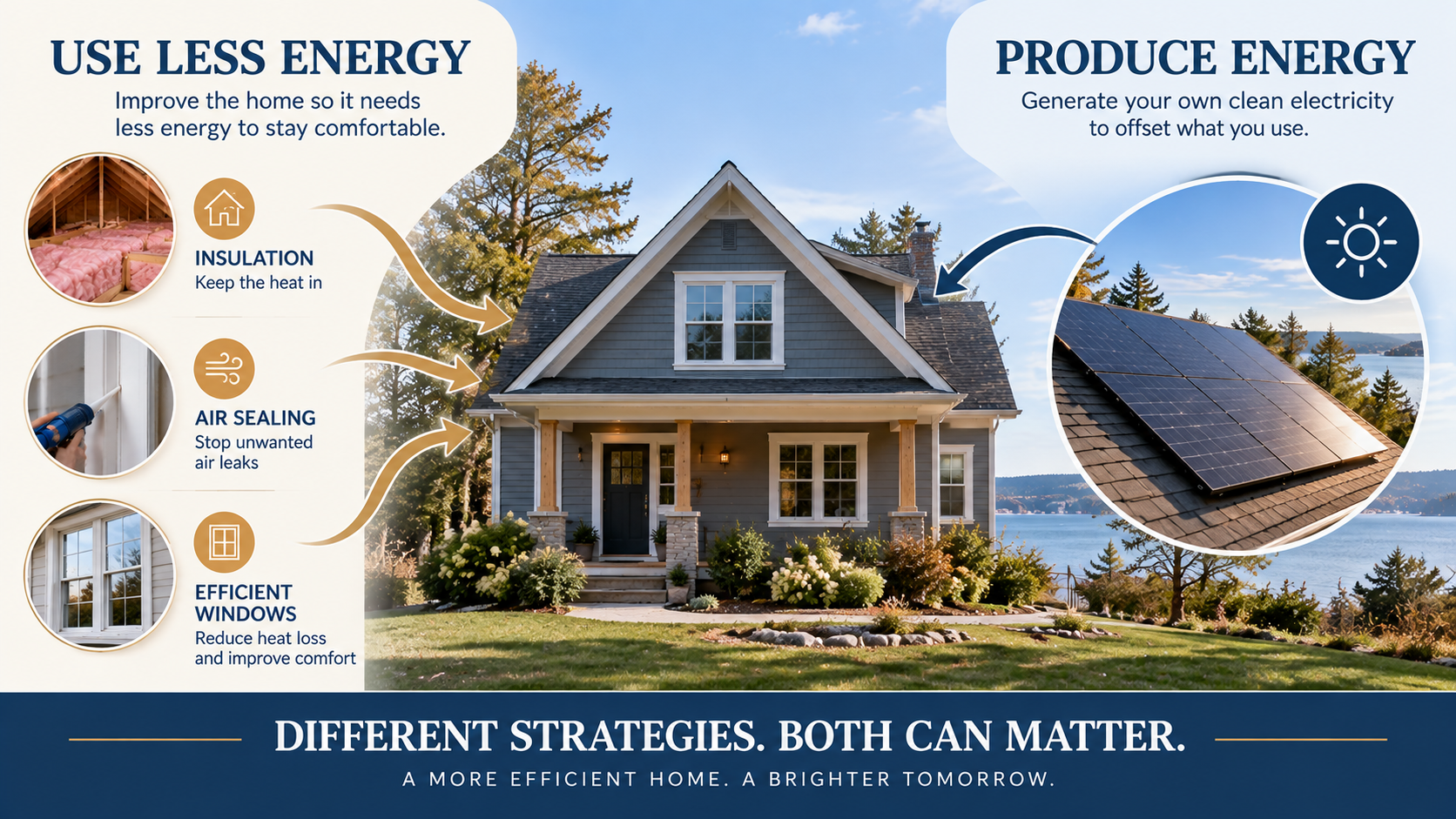
8. Solar Panels: Reduce the Bill or Reduce the Consumption?
Solar creates another important distinction.
Solar photovoltaic panels don't make the house itself require less energy.
They produce electricity.
That's different from insulation, air sealing or better windows, which can reduce the energy demand of the building.
Neither approach is inherently better.
They're solving different problems.
Imagine two identical homes using 20,000 kWh per year.
One adds solar panels that offset part of the electricity it purchases.
The other reduces its underlying energy consumption through envelope and mechanical improvements.
Both may end up purchasing less energy.
But they got there differently.
That's why before considering solar, I'd want to understand:
How much energy does the house currently use—and why?
If the house has obvious efficiency problems, it may make sense to investigate those alongside—or before—sizing a solar system.
On the other hand, a house that's already reasonably efficient may be a very different solar candidate.
Producing energy and needing less energy are two different sides of the equation.
Solar Panels vs. Passive Solar: What's the Difference?
9. Don't Forget About the Cost You Were Already Going to Spend
This can completely change the payback calculation.
Imagine your roof needs replacement.
You're going to spend money on the roof regardless.
If an energy-related improvement can be incorporated into that project, the relevant question may not be:
“What does the entire project cost?”
It may be:
“What does the energy upgrade add to a project I already have to do?”
The same applies to:
replacing siding
finishing a basement
replacing failed windows
replacing an old heating system
renovating an attic
opening walls
replacing a roof before solar installation
That incremental cost can sometimes be much more useful than looking at the full project price.
A $20,000 renovation that was required anyway isn't necessarily a $20,000 energy upgrade.
10. Comfort Has Value Too
This is where a strict payback calculation can miss part of the story.
Suppose an insulation and air-sealing project saves a modest amount each year.
But afterward:
The bedroom above the garage isn't freezing.
The floor isn't cold.
The drafts beside the windows disappear.
The basement becomes more comfortable.
The heating system cycles less aggressively.
How much are those things worth?
That's subjective.
But they're real.
Likewise, new windows may improve comfort, operation, condensation resistance and appearance even if their energy savings alone don't justify their entire cost.
A heat pump may provide cooling.
Solar may provide some protection against future purchased-electricity costs.
Not every benefit appears on the heating bill.
11. And Maintenance Can Change the Calculation
Suppose you're comparing keeping an old oil heating system with installing a heat pump.
The comparison isn't necessarily just:
Oil cost vs. electricity cost.
There may also be:
furnace or boiler maintenance
oil-tank replacement
chimney maintenance
equipment replacement
cooling equipment
backup heating requirements
Likewise, keeping deteriorating windows may eventually involve repair and maintenance costs.
When an existing component is approaching the end of its useful life, the economics of upgrading can change substantially.
You're no longer comparing:
Do nothing vs. spend $15,000.
You may be comparing:
Spend $10,000 replacing the old system with something similar
versus
Spend $15,000 replacing it with something more efficient.
Now the energy-efficiency decision is really about the difference between those options.
12. Rebates and Incentives Matter—But They Change
Government and utility programs can have a major effect on retrofit economics.
They can also change.
That means I wouldn't build a long-term renovation strategy around an incentive without checking that the program is still available and that the specific project qualifies.
NRCan's Greener Homes Initiative illustrates how widely homeowners' choices can vary. As of February 2026, the most common funded retrofit nationally was heat pumps, followed by windows and doors, insulation, air sealing and solar panels. Natural Resources Canada
But popularity doesn't tell us which upgrade is best for your house.
It tells us what people chose.
Those are very different things.
Before proceeding with a project, check current federal, provincial and utility programs—and eligibility requirements—rather than relying on an old article, quote or neighbour's experience.
13. What About Resale Value?
This is another area where I'd be careful about promising a universal return.
I wouldn't tell a homeowner:
“Spend $20,000 on this and your house will be worth $25,000 more.”
Real estate doesn't work that neatly.
Value depends on:
the property
location
market conditions
buyer expectations
quality of the work
age of the improvement
comparable properties
how significant the upgrade is to that particular home
But energy improvements can absolutely become part of the story a home tells.
A buyer may value documented:
low energy consumption
good insulation
improved airtightness
efficient heating
quality windows
solar generation
an EnerGuide evaluation
professional installation records
Especially when the seller can provide evidence rather than simply saying:
“It's very energy efficient.”
Documentation matters.
Buying an Energy-Efficient Home? Here's What to Look For
14. The Cheapest Upgrade Can Sometimes Beat the Most Impressive One
Imagine someone spends thousands of dollars replacing windows.
Meanwhile, a poorly sealed attic hatch and several major attic penetrations continue leaking heated air.
The windows may be better.
The house may look better.
But was that the best first investment?
Maybe.
Maybe not.
That's why I like separating upgrades into two questions:
WHAT IS THE PROBLEM?
Where is energy being wasted?
WHAT IS THE MOST PRACTICAL WAY TO FIX IT?
That might be a $500 air-sealing project.
It might be $5,000 of insulation.
It might be a new heating system.
It might be windows.
It might be solar.
It could be a combination.
The price tag doesn't tell you the priority.
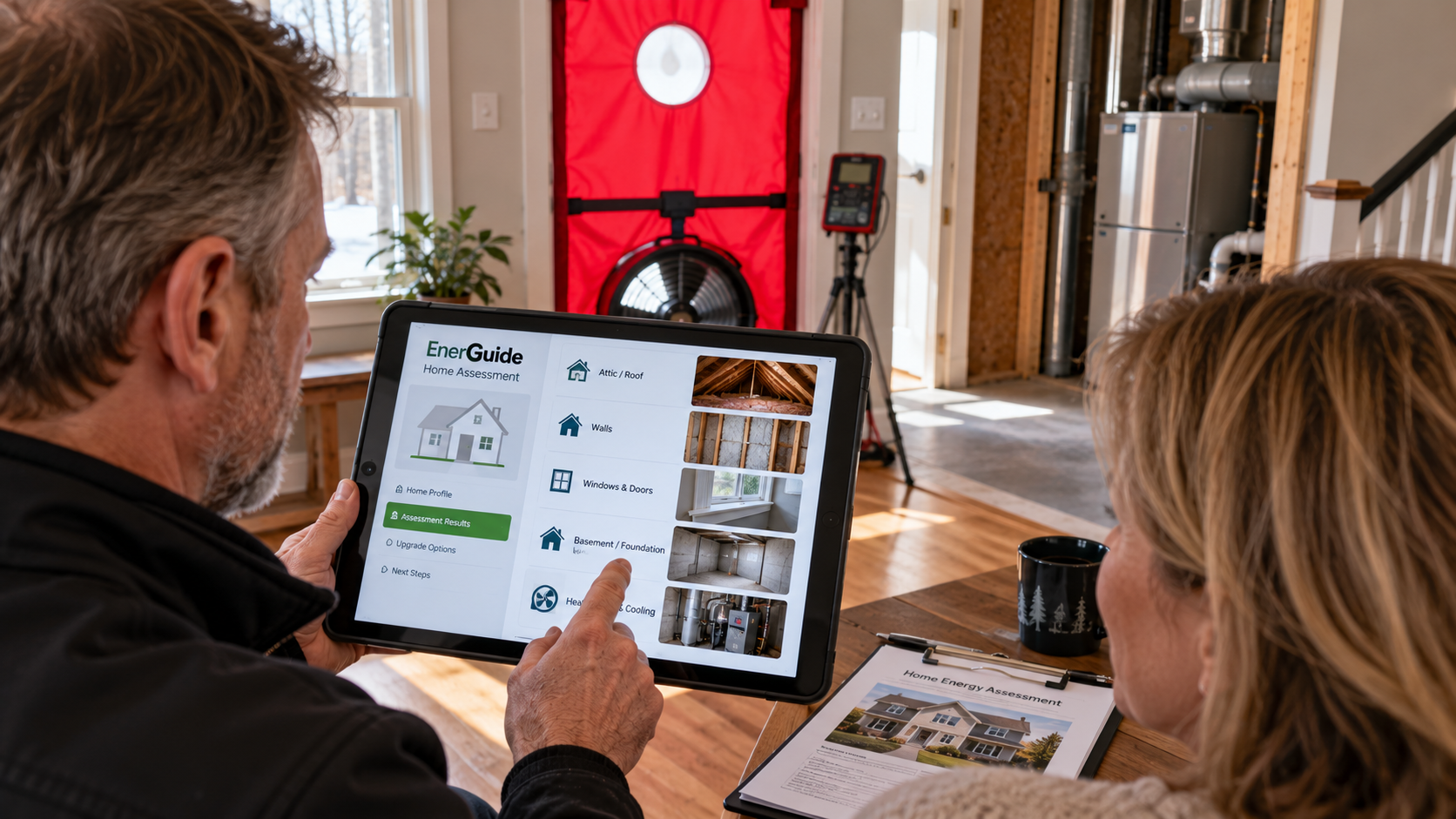
15. This Is Where an EnerGuide Evaluation Can Be Valuable
If you're planning several major energy upgrades, measuring before spending can make a lot of sense.
An EnerGuide home evaluation assesses the house and provides an EnerGuide rating, Homeowner Information Sheet and Renovation Upgrade Report. NRCan describes the evaluation as a way to help homeowners determine which upgrades can save energy and improve comfort. Natural Resources Canada
Instead of starting with:
“I want new windows.”
you can start with:
“Where is this house using energy, and where are the opportunities?”
That's a much better foundation for a renovation plan.
And if you're making several improvements over a number of years, it can also help you think about the order in which they should happen.
16. So Which Upgrade Should Come First?
Rather than giving every homeowner the same answer, I'd work through something like this:
Is something failing or due for replacement anyway?
That may create an obvious opportunity.
Where is the house losing heat?
Look at insulation, airtightness, windows, doors, foundation and other parts of the envelope.
How is the house currently heated?
An expensive or inefficient heating source may create a significant opportunity.
Are there inexpensive problems that can be corrected first?
Air sealing is a good example.
Are major renovations already planned?
Take advantage of walls, roofs, siding or basements while they're accessible.
Will one upgrade affect another?
Envelope improvements can affect heating loads. Air sealing can affect ventilation needs.
What are you trying to accomplish?
Lower bills?
Better comfort?
Cooling?
Lower emissions?
Less maintenance?
Prepare for solar?
Improve the house before selling?
Different goals can produce different priorities.
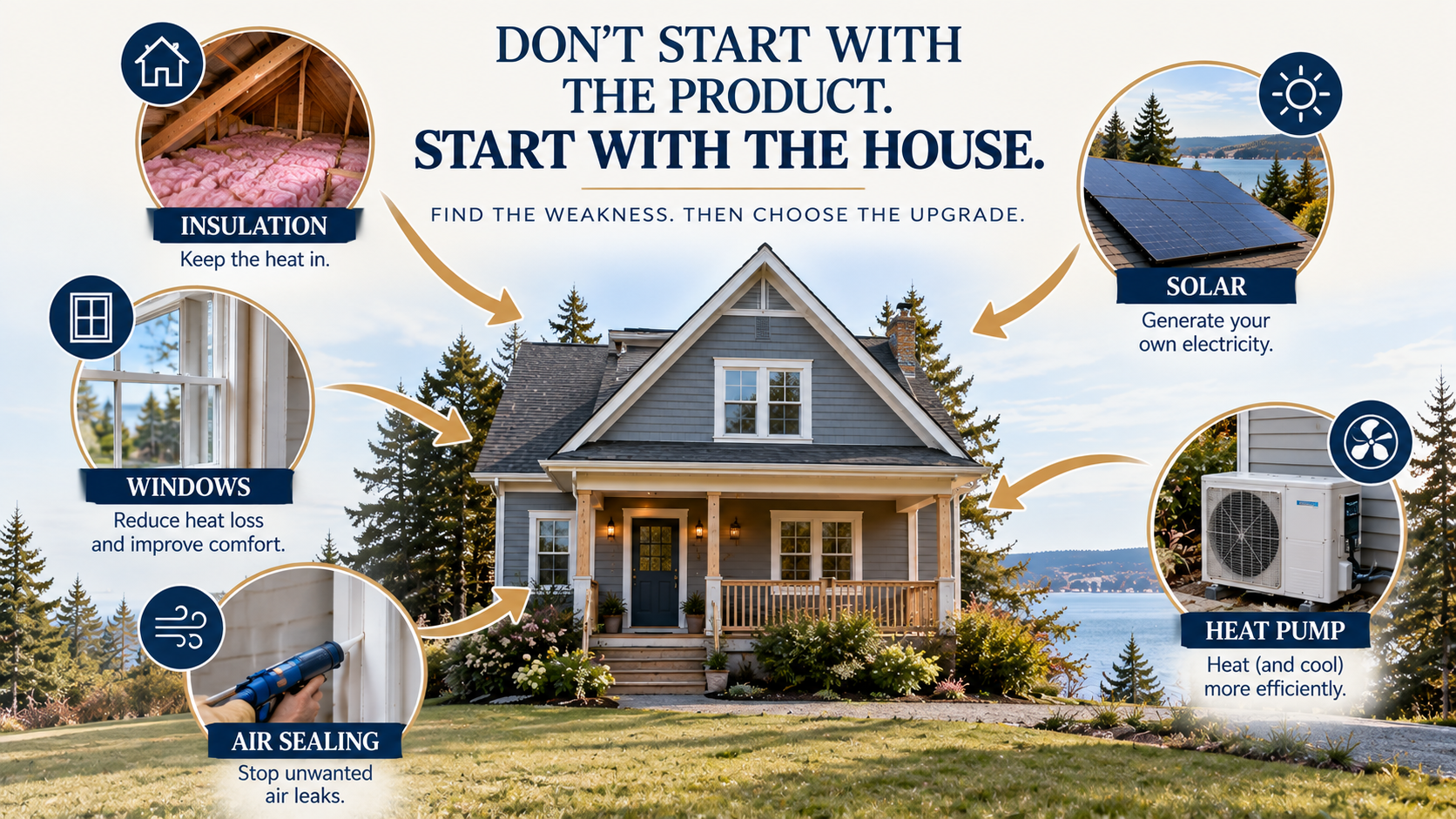
Don't Start With the Product. Start With the House.
It's easy to shop for energy efficiency.
Windows have brochures.
Heat pumps have efficiency ratings.
Solar systems have production estimates.
Insulation has R-values.
But the best retrofit strategy doesn't start in a showroom.
It starts with the house.
Where is it losing energy?
What equipment is it using?
What's already working well?
What's approaching the end of its life?
What renovations are already planned?
What does the homeowner actually want to accomplish?
Only then does it make sense to start comparing solutions.
Because the question isn't:
“Which energy-efficient upgrade has the best ROI?”
It's:
“Which upgrade gives this house the most useful improvement for the money?”
And those can be very different answers.
Smarter, Greener Homes
This article is part of my Smarter, Greener Homes series, where I take a practical look at energy efficiency, green building and the features that can affect how comfortable and economical a home is to operate.
One theme has come up again and again throughout this series:
A house is a system.
Insulation affects heat loss.
Air sealing affects leakage.
Windows affect heat loss and comfort.
Heating equipment affects how efficiently we replace lost heat.
Ventilation affects how we provide fresh air.
Solar can affect how much electricity we need to purchase.
That's why I don't think energy-efficient renovations should be treated as a shopping list.
Find the weakness. Understand the house. Then choose the upgrade.
As a Canadian Certified Green Representative (CCGR), I bring that whole-house perspective into the buying and selling process, helping clients better understand the energy-efficient and green-building features they encounter in Nova Scotia homes.
Thinking about buying a home with energy upgrades—or trying to make sense of improvements you're considering in your own home?
Get in touch. I'm always here to help.
Rob Schellenberger, REALTOR®
Canadian Certified Green Representative
RE/MAX Banner Real Estate
902-300-8674
robschellenberger.ca
.jpg)