.png)

Part of the Smarter, Greener Homes series: Practical guides to understanding energy efficiency, home performance and green-building features.
Throughout this series, I've talked quite a bit about making homes more airtight.
Seal the gaps.
Stop the drafts.
Control air leakage.
Keep the heat you've already paid for inside the house.
So there's an obvious question:
If we keep sealing up the house, how does fresh air get in?
The answer shouldn't be:
Through random cracks in the walls.
A well-performing home still needs fresh air. The difference is that instead of relying on uncontrolled leakage, we can use controlled ventilation.
That's where an HRV—or Heat Recovery Ventilator—comes in.
An HRV brings fresh outdoor air into the home while exhausting stale indoor air. But rather than simply throwing all of the heat in that outgoing air outside, it transfers some of that heat to the incoming fresh air. Natural Resources Canada describes HRVs as one of the most effective ways to ventilate a tightly built home while maintaining comfort and energy efficiency. Natural Resources Canada
In other words:
Make the house tighter. Then decide where, when and how fresh air comes in.
1. First, Why Not Just Let the House “Breathe”?
You've probably heard someone say:
“A house needs to breathe.”
There's an important idea buried in that statement—but I think the wording can be misleading.
People need fresh air. Buildings need to manage air and moisture properly.
Random cracks and gaps aren't a ventilation system.
Air leaking through window frames, attic penetrations, electrical openings and gaps in the building envelope happens according to wind, temperature and pressure differences—not according to how much fresh air the occupants actually need.
On a windy January night, you may get plenty of leakage.
On a calm day, you may get much less.
And the incoming air isn't necessarily arriving where you want it.
NRCan notes that even conventional homes with air infiltration through doors, windows and other openings may not receive adequate ventilation—or distribute that fresh air to the rooms where it's actually needed. Natural Resources Canada
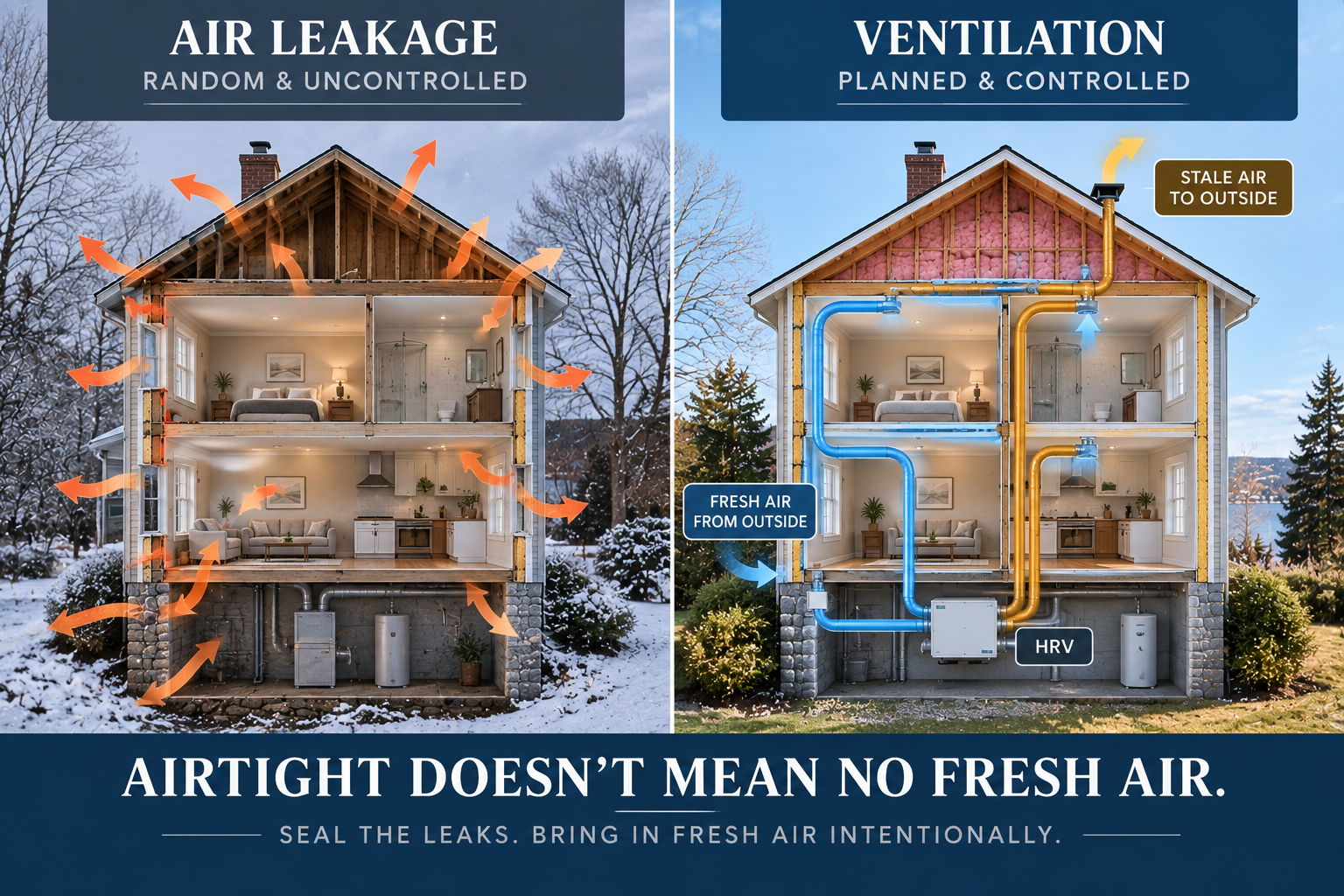
That's the difference between air leakage and ventilation.
Air leakage is uncontrolled. Ventilation is intentional.
Your House May Be Leaking Money — Understanding Air Sealing
2. What Does an HRV Actually Do?
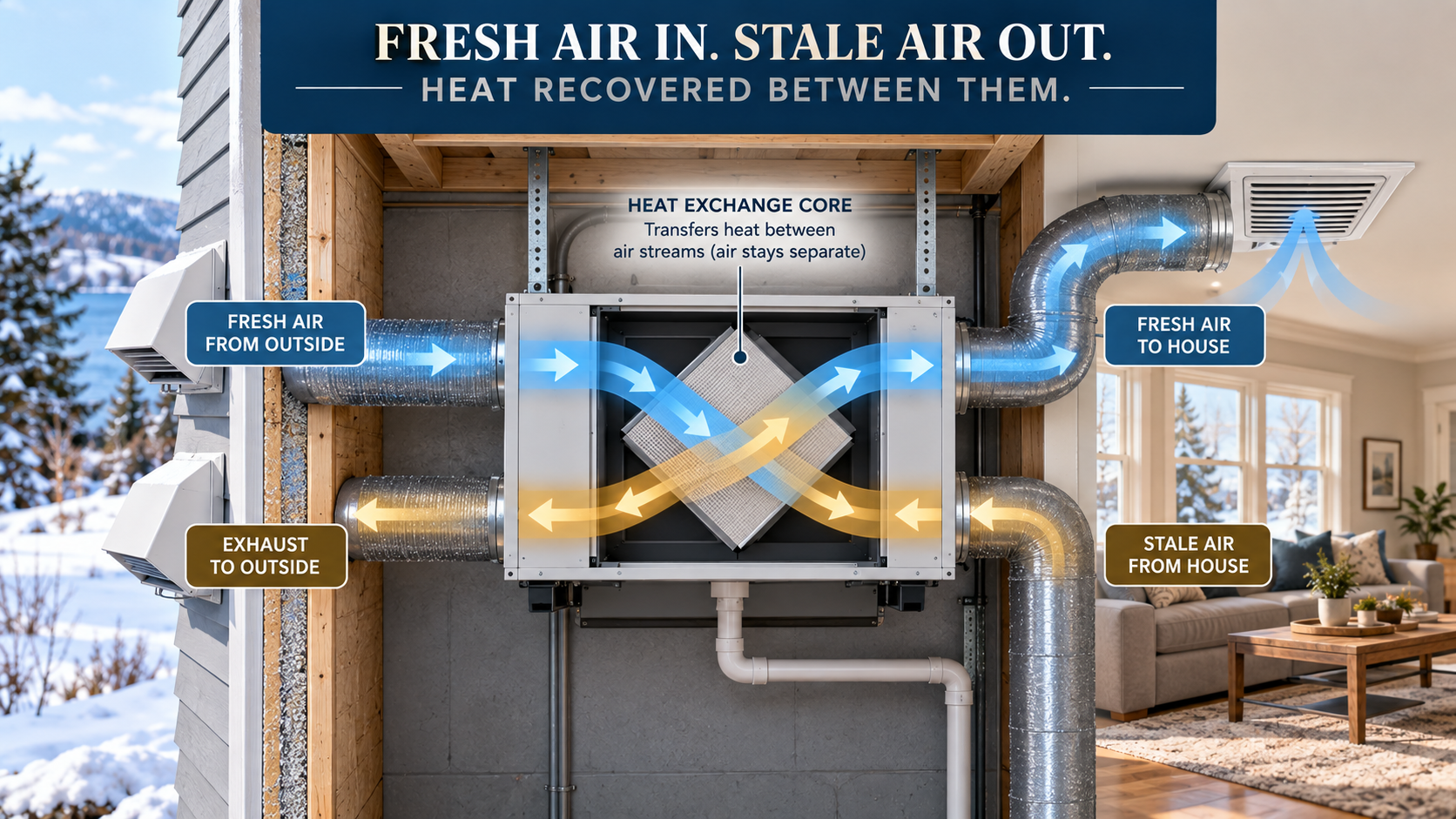
At its simplest, an HRV manages two separate streams of air.
One is going out.
One is coming in.
STALE AIR OUT
The system removes stale indoor air, often drawing from areas such as bathrooms and other locations where moisture and pollutants can accumulate.
FRESH AIR IN
At the same time, it brings filtered outdoor air into the house and distributes it to living areas.
But here's the important part:
Those two streams pass through a heat-exchange core.
During the heating season, the warm stale air leaving the house transfers some of its heat to the colder fresh air coming inside.
The two air streams remain separate—they don't simply mix together. Natural Resources Canada
So imagine it's cold outside.
Instead of bringing very cold outdoor air directly into the house and asking the heating system to warm it entirely from outdoor temperature, the HRV uses heat that was already in the outgoing air to preheat the incoming fresh air.
You're replacing the air without unnecessarily throwing away all of the heat that was in it.
3. An HRV Doesn't “Recycle” the Stale Air
This is worth clarifying because the term heat recovery can make the system sound like it's recycling indoor air.
That's not what's happening.
The HRV is recovering heat from the air, not simply sending the stale air back into the house.
Think of the two air streams passing beside each other through the heat exchanger.
Outgoing stale air → transfers heat → then goes outside.
Incoming fresh air → receives some of that heat → then enters the house.
NRCan's HRV guidance specifically describes the supply and exhaust streams as separate within the unit. Natural Resources Canada
That's an important distinction.
The air goes out. Some of its heat stays behind.
4. Why Not Just Open a Window?
You absolutely can open a window.
And sometimes you should.
But opening windows isn't a particularly controlled whole-house ventilation strategy—especially during a Nova Scotia winter.
Imagine opening a window when it's -10°C outside.
Fresh air comes in.
Warm indoor air goes out.
The heating system replaces the heat you've just lost.
An HRV is designed to accomplish the ventilation part while recovering a significant portion of the heat from the outgoing air.
NRCan's Keeping the Heat In guide says HRVs typically recover about 70 to 80 percent of the heat from exhaust air and transfer it to incoming air. Actual performance varies by unit and operating conditions. Natural Resources Canada
So an HRV doesn't eliminate the energy cost of ventilation.
The fans use electricity, and the incoming air may still need additional heating.
But it can make controlled ventilation considerably more energy efficient than simply exhausting warm air and replacing it with untreated cold outdoor air.
5. Why Does Airtightness Make Ventilation More Important?
Consider two houses.
HOUSE A
It's relatively leaky.
Outdoor air enters through cracks around windows, doors, attic penetrations and other gaps.
Indoor air escapes through other openings.
There is plenty of air movement—but little control over how much, when or where.
HOUSE B
It's considerably tighter.
The uncontrolled leakage has been reduced.
That's good for energy performance and comfort.
But now we can't assume random gaps will provide adequate fresh air.
As uncontrolled ventilation decreases, controlled ventilation becomes more important.
NRCan notes that modern airtight homes use mechanical ventilation specifically to complement that airtightness. It also points out that existing homes undergoing insulation, air sealing and window upgrades can reach the same point where mechanical ventilation becomes increasingly important. Natural Resources Canada
That's why air sealing and ventilation aren't contradictory ideas.
They're partners.
Air sealing controls the air you don't want moving through the house.
Ventilation controls the air you do.
6. What Is the HRV Actually Removing?
“Stale air” sounds fairly harmless.
But think about what happens inside a house every day.
We:
cook
shower
wash dishes
dry clothes
clean
sleep
breathe
use household products
bring furniture and materials into the home
All of those activities can affect indoor air.
Moisture is particularly important.
Showers, cooking, people and everyday activities continually add water vapour to indoor air.
NRCan identifies excess moisture, moulds, household chemicals and other pollutants among the things ventilation can help remove from a home. Natural Resources Canada
That's why ventilation isn't just about making the house feel less stuffy.
It's part of managing the indoor environment.
7. Humidity Is Part of the Conversation
Winter humidity can be a balancing act.
Too much indoor moisture can contribute to:
condensation on windows
dampness
mould growth
potential moisture problems in parts of the building
NRCan specifically identifies heavy window condensation, dampness and mould as potential signs of excessive indoor moisture and recommends ventilation—including HRVs—as one way of helping control it. Natural Resources Canada
But you don't necessarily want the house excessively dry either.
That's one reason the ventilation system needs to be properly selected and operated for the home and climate.
And it leads us to another piece of equipment you may encounter.
8. HRV vs. ERV: What's the Difference?
You may see either term when looking at homes:
HRV — Heat Recovery Ventilator
ERV — Energy Recovery Ventilator
They're closely related.
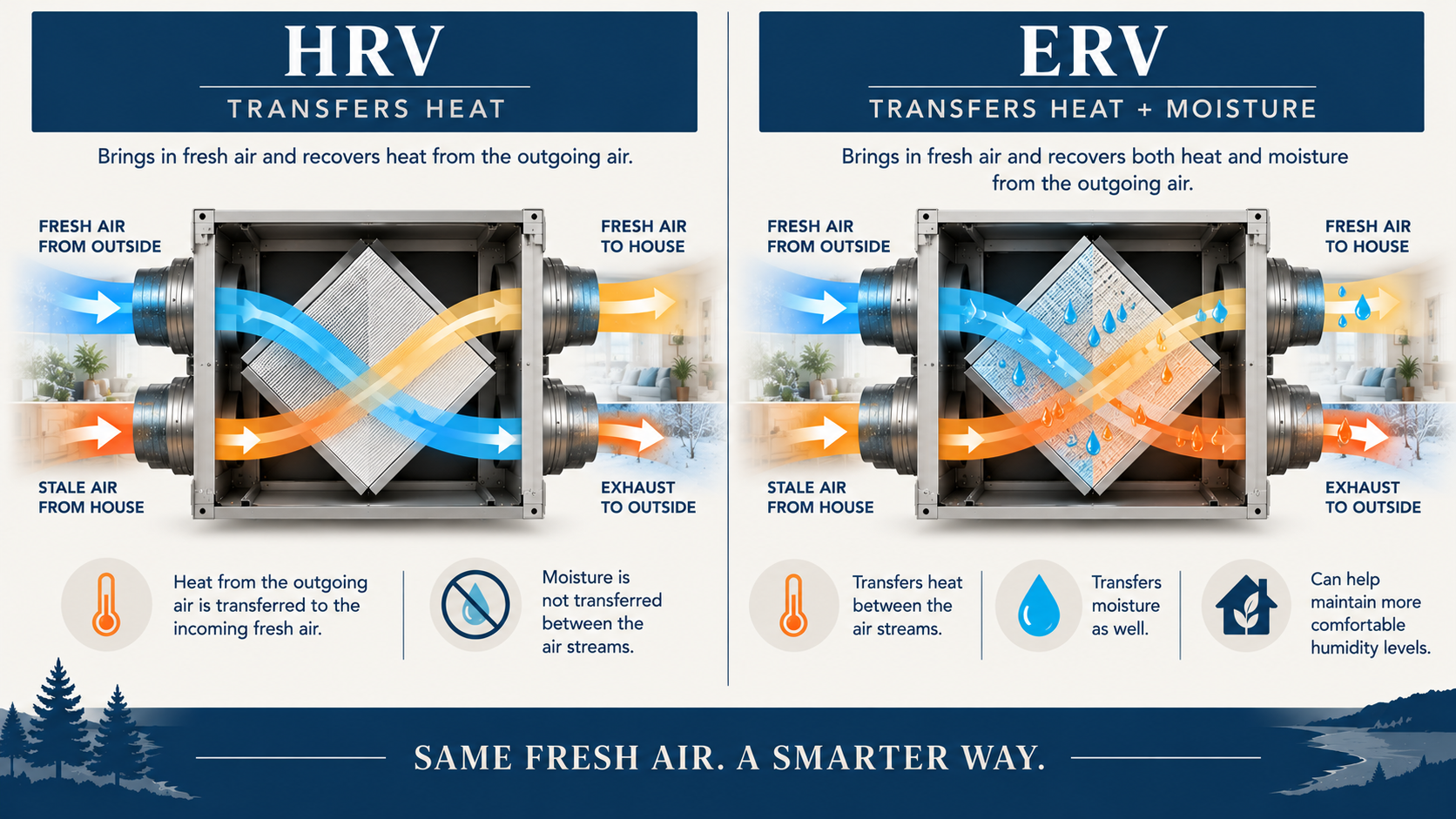
Both exchange stale indoor air for fresh outdoor air and recover heat.
The primary difference is moisture.
HRV
Transfers heat between the two air streams.
ERV
Transfers heat and moisture.
NRCan explains that an ERV can help retain some indoor moisture during very dry winter conditions and help manage incoming moisture during warm, humid weather. Natural Resources Canada
Does that mean an ERV is automatically better?
No.
Climate, the house, occupancy and indoor humidity all matter. NRCan specifically recommends choosing between them based on the home's conditions and local climate rather than assuming there is one correct option everywhere. Natural Resources Canada
HRV and ERV solve similar problems slightly differently.
For a buyer, the first step is simply understanding which system the house has and how it's being used.
9. Where Does the Fresh Air Go?
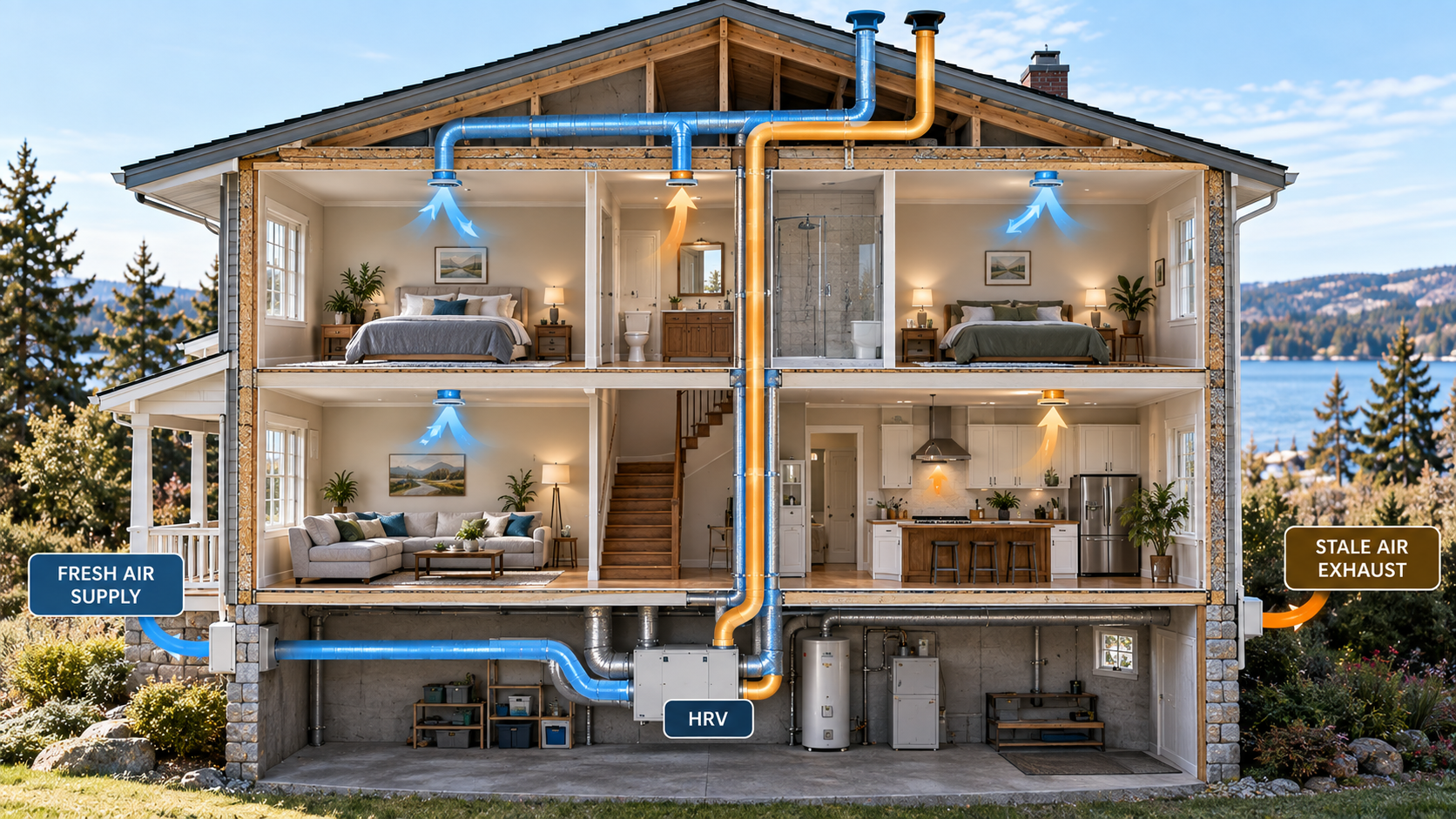
A properly designed whole-house ventilation system isn't just a box hanging in the basement.
The distribution matters.
Depending on the house and installation, an HRV can have dedicated ductwork or be integrated with an existing forced-air distribution system. NRCan notes that HRV/ERV systems should be designed so supply and exhaust airflows are appropriately balanced. Natural Resources Canada
Generally, the objective is to remove stale or moist air from appropriate areas and provide fresh air to living spaces.
So when I'm looking at an HRV in a home, I'm interested in more than:
“Does it have one?”
I'd also want to understand:
Where does it exhaust from?
Where does it supply fresh air?
Is there dedicated ductwork?
Is it connected to another air-distribution system?
Does the installation make sense for the house?
The equipment matters.
So does what it's connected to.
10. Balance Matters
Remember those two air streams?
Fresh air coming in.
Stale air going out.
Ideally, they're working in a controlled relationship.
NRCan emphasizes that HRV and ERV supply and exhaust airflows should be balanced to maximize performance and avoid undesirable pressure effects within the house. Natural Resources Canada
Why does pressure matter?
Because a house doesn't exist in isolation.
It may also contain:
fireplaces
wood stoves
oil furnaces
boilers
propane appliances
exhaust fans
range hoods
clothes dryers
All of these can affect air movement and pressure.
That's particularly important when fuel-burning equipment is involved.
It's another reason ventilation systems should be properly designed and installed rather than treated as simply another appliance to hang on the wall.
11. Does an HRV Run All the Time?
This surprises some homeowners.
NRCan's current guidance for ENERGY STAR certified HRV/ERV equipment recommends that the system remain running except when it's being serviced. Natural Resources Canada
That doesn't necessarily mean it always operates at the same airflow.
Systems can have different controls and operating modes depending on their design.
You may encounter:
continuous low-speed operation
higher-speed ventilation when needed
timer controls
humidity-related controls
bathroom boost controls
programmable controls
How the system should be operated depends on the equipment and installation.
The important point is that an HRV isn't something that should simply be installed and forgotten.
It's part of how the house manages fresh air.
12. What Happens in Really Cold Weather?
Now we're getting into the part that's particularly relevant in Canada.
Cold outdoor air contains less heat.
At sufficiently low temperatures, moisture from the outgoing indoor air can freeze inside portions of the HRV.
Manufacturers therefore use different frost-control or defrost strategies.
Depending on the unit, the system may temporarily alter airflow or operation to prevent excessive frost buildup.
That's normal system behaviour.
It's also one reason that when evaluating an HRV, I'd want to know the actual model rather than simply seeing the letters HRV on a listing.
Equipment is tested and rated for its performance under specific conditions, and NRCan's regulatory framework includes heat-recovery performance at cold outdoor temperatures as an important performance measure. Natural Resources Canada
For Nova Scotia buyers, cold-weather performance isn't a theoretical specification.
It's part of the job.
13. HRVs Need Maintenance Too
Like a heat pump or furnace, an HRV isn't maintenance-free.
There are:
filters
intake and exhaust hoods
fans
a heat-exchange core
ductwork
drainage components on some systems
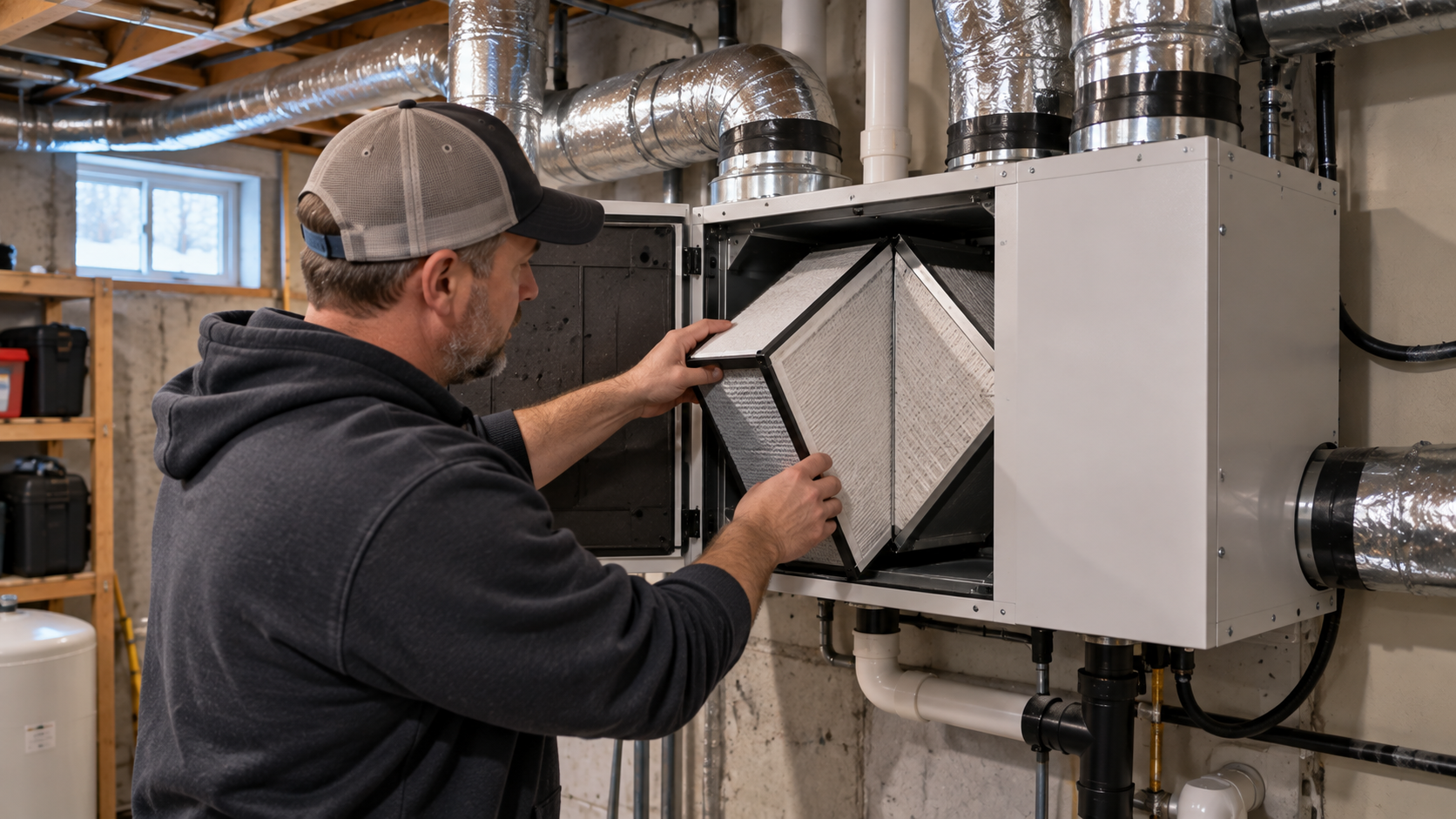
NRCan recommends cleaning HRV/ERV filters approximately every one to three months, following the manufacturer's instructions, and arranging annual servicing by an accredited contractor. Natural Resources Canada
The outdoor intake and exhaust also need to remain unobstructed.
In Nova Scotia, that means I'd be paying attention to things such as snow, ice, leaves and debris around the exterior hoods.
An HRV that's installed but poorly maintained may not be doing the job you assume it is.
Having the equipment and maintaining the equipment are two different things.
14. Can You Add an HRV to an Older Home?
Yes.
HRVs aren't limited to new construction.
This becomes particularly relevant after the previous article in this series.
An older home may have undergone substantial upgrades:
attic insulation
wall insulation
basement insulation
replacement windows
extensive air sealing
new exterior doors
Those improvements can dramatically change how much uncontrolled air moves through the building envelope.
NRCan specifically notes that mechanical ventilation can be needed in conventional existing homes because random infiltration doesn't necessarily provide adequate or well-distributed fresh air. Natural Resources Canada
So an HRV can be part of a thoughtful older-home retrofit too.
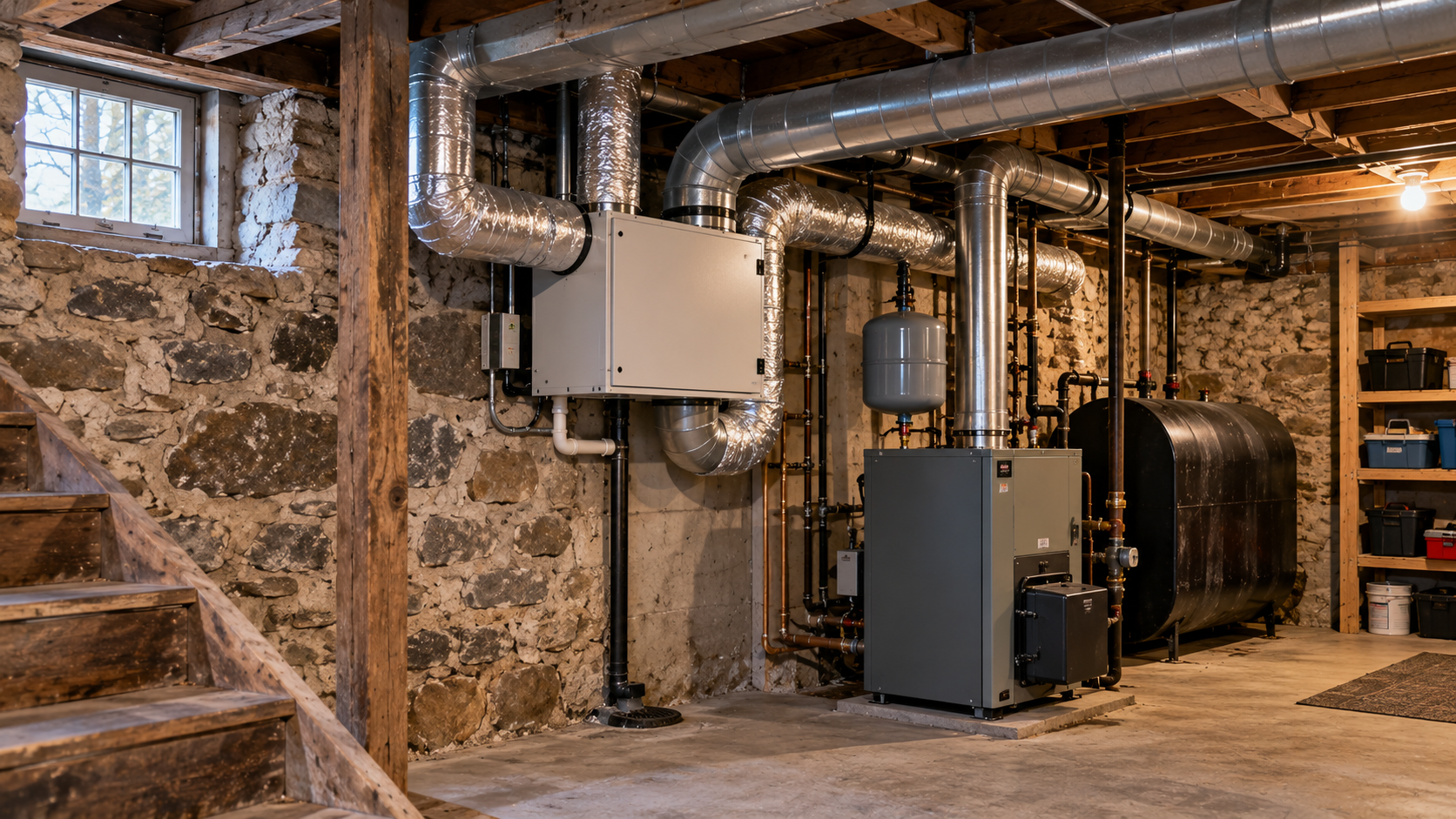
But retrofitting ductwork into a finished century home can obviously be more complicated than designing it into a new house from the beginning.
The installation needs to suit the particular building.
Is an Older Home Automatically Less Energy Efficient?
15. Does Every House Need an HRV?
This is where I wouldn't make a blanket statement.
The ventilation needs of a house depend on factors including:
airtightness
size
occupancy
existing ventilation
moisture levels
heating equipment
combustion appliances
renovations
how the home is used
A very leaky older house and an extremely airtight high-performance house are obviously starting from different places.
But remember something important:
Being leaky doesn't necessarily mean being well ventilated.
Random air leakage isn't designed to remove pollutants from where they're generated or deliver fresh air where people need it.
That's why the better question isn't simply:
“Does every house need an HRV?”
It's:
“How is this particular house getting the ventilation it needs?”
16. What Should Buyers Look For?
If a home has an HRV or ERV, I'd want to investigate a few things.
IDENTIFY THE EQUIPMENT
Is it an HRV or ERV?
What's the make and model?
Approximately how old is it?
LOOK AT THE INSTALLATION
Where is the unit?
Where are the ducts going?
Does it use dedicated ventilation ductwork or integrate with another system?
CHECK THE EXTERIOR
Can you identify the intake and exhaust hoods?
Are they clear and unobstructed?
ASK ABOUT OPERATION
Does the homeowner run it continuously?
Are there boost controls in bathrooms?
Is there a humidity control?
LOOK AT MAINTENANCE
When were the filters last cleaned?
Has the unit been professionally serviced?
Is the core clean?
Is the condensate drain functioning where applicable?
ASK FOR DOCUMENTATION
Is the owner's manual available?
Installation invoice?
Maintenance records?
Any balancing or commissioning information?
LOOK AT THE REST OF THE HOUSE
Is there persistent window condensation?
Does the house smell unusually stale or musty?
Are bathrooms excessively humid?
Are there fuel-burning appliances that also need to be considered?
You don't need to become an HVAC technician during a showing.
But these questions can tell you whether the ventilation system deserves a closer look during your due diligence.
The Goal Isn't a House That Doesn't Breathe
This is really the concept I want buyers to take away from this article.
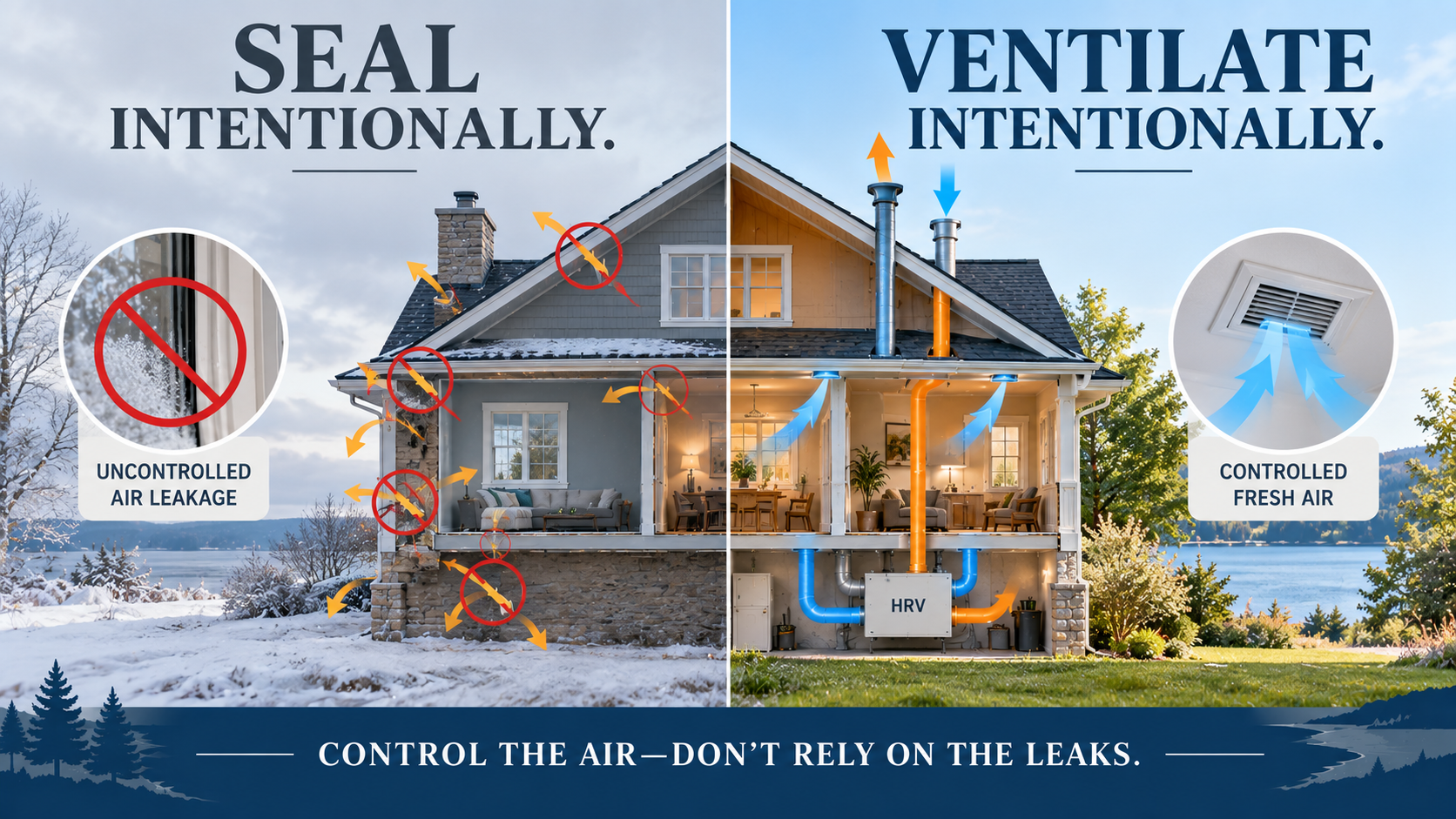
When we talk about air sealing, the goal isn't to create a house with no fresh air.
It's to stop depending on random holes in the building envelope to provide it.
Think back to the distinction:
Uncontrolled air leakage:
Air goes wherever pressure differences happen to push or pull it.
Controlled ventilation:
Fresh air enters where we've designed it to enter, stale air leaves where we've designed it to leave, and an HRV can recover some of the heat along the way.
That's a much more useful way to think about an airtight home.
Seal the house intentionally.
Ventilate the house intentionally.
Those two ideas belong together.
Smarter, Greener Homes
This article is part of my Smarter, Greener Homes series, where I take a practical look at energy efficiency, green building and the features that can affect how comfortable and economical a home is to operate.
We've already looked at insulation and air sealing—two of the biggest pieces of the building envelope.
But tightening the building envelope changes the way the house works.
Once we reduce uncontrolled air leakage, we still need to think about fresh air, moisture and ventilation.
That's why energy-efficient homes need to be understood as systems.
Insulation slows heat loss.
Air sealing controls leakage.
Ventilation controls fresh air.
Heat recovery helps us do that without unnecessarily throwing away the energy we've already paid for.
As a Canadian Certified Green Representative (CCGR), I bring that whole-house perspective into the buying and selling process, helping clients better understand the energy-efficient and green-building features they encounter in Nova Scotia homes.
Thinking about buying a home with an HRV or ERV—or wondering what that box in the mechanical room actually does?
Get in touch. I'm always here to help.
Rob Schellenberger, REALTOR®
Canadian Certified Green Representative
RE/MAX Banner Real Estate
902-300-8674
robschellenberger.ca
.jpg)